The Science of Genetic Engineering as it Relates to The California Right to Know GE Food Act

I’ll be participating in an educational event related to “The California Right to Know Genetically Engineered Food Act” this Friday, March 23rd, from 7-8:30 pm.

The event, entitled “What Am I Eating? A Raphael Garden Community Conversation,” will be held on the Rudolf Steiner College campus in Fair Oaks, CA.


Update (April/2012): The presentation I gave at the Rudolf Steiner College event has been posted on the Resources page of this blog.

Posted in Biotechnology | 1 Comment

Crop Genetic Engineering is a Mutagenic Process

In my last post I argued that the current system for regulating genetically engineered (GE) crops for commercialization in the United States is inadequate because it is possible to design GE plants in such a way that USDA, EPA or FDA regulation of them–and therefore any regulation of them in the U.S.–is not required.  But I only briefly mentioned one reason why GE crops need to be regulated in the first place: the technologies used to create them are highly mutagenic.

Proponents of agricultural genetic engineering tout the “precision” of the technology and, compared to traditional plant breeders, genetic engineers do have very precise knowledge of the genes they select for insertion into crop plants; they know those genes right down to their exact DNA sequences.  But, what proponents of the technology may neglect to mention is that genetic engineers don’t have any control at all over where in a recipient plant those selected DNA sequences will land.  And they often–estimates indicate 27-63% of the time in plants like rice and Arabidopsis (a “model” plant often used for research) –land right smack dab in the middle of some random gene in the recipient plant, disrupting its function and thereby mutating it.  Published reports (see Latham et al., 2006 and references therein) also indicate that engineering genes into a recipient plant’s DNA is nearly always accompanied by small or substantial deletions or rearrangements of recipient plant DNA, insertions of DNA sequences not intended for insertion (usually of bacterial origin), and “somaclonal” variation (heritable changes associated with the process of regenerating into whole, fertile plants the individual plant cells that have had foreign genes inserted into them).  These are all highly probable and randomly occurring consequences associated with crop genetic engineering as it is currently practiced.  So in fact, there is actually a great deal of imprecision associated with inserting a gene or genes into crop plants via genetic engineering.

Depending on the functions of the gene(s) affected, unintended mutations could result in altered levels of things normally found in the recipient plants like pigments, nutrients or even toxins like the glycoalkaloids found in green potatoes.  Mutations that result in visible changes, like yellow plants as a result of reduced levels of the green pigment chlorophyll, are easy enough to winnow out.  But GE plants that contain unintended mutations that don’t result in changes in their outward appearance are harder to eliminate.  And it is possible that unintended mutations resulting from the process(es) of genetic engineering itself, as opposed to the products of the particular foreign gene(s) genetically engineered into a crop plant, could negatively impact GE food and feed products.  For example, the possibility that negative impacts reported in laboratory animals fed GE corn or GE potatoes might be related to unintended mutations in those GE products has not, to my knowledge, been ruled out.

The value of utilizing animal feeding studies to determine the safety of GE foods is debatable.  The FDA has stated that “feeding studies on whole foods have limited sensitivity because of the inability to administer exaggerated doses” (as opposed to feeding studies carried out with individual chemicals).  But molecular genetic methods for identifying many unintended changes in GE plants are available and FDA should require developers to use them prior to approving any GE food crop for commercialization.  Instead, as noted in a previous post (12/7/11), FDA doesn’t require any regulation of most GE food or feed products at all.

Many developers of GE crops are already testing their potential products for unintended changes that might have occurred during the genetic engineering process and discarding any mutant plants they may have identified.  We did at Calgene prior to commercializing the Flavr Savr™ tomato.  But the testing process should be made mandatory for commercialization.  U.S. regulatory policies regarding GE foods should be changed accordingly.

Posted in Biotechnology | Tagged , , , , , , , , , , , , | 5 Comments

Regulating Genetically Engineered Crops in the U.S.: Forcing a Square Technology Peg into a Round Regulatory Hole

Despite what you may have read in The New York Times or on Monsanto’s website or in books like some written by former regulatory officials, current regulation of genetically engineered (GE) crops in the United States is not necessarily “burdensome” and not “every biotechnology product has to be submitted to two or more [government agencies] for approval.”   In the first place (and as I mentioned in a post on 11/9/11), one of the three U.S. agencies making up the “coordinated framework” that deals with biotech crops, the Food and Drug Administration (FDA), does not require regulation of most GE foods or feeds at all.

In its 1992 original “Statement  of  Policy: Foods Derived from New Plant Varieties,” the FDA described the “genetic modification techniques” used to traditionally breed crop plants and those used to genetically engineer them as constituting a “continuum.”  Nearly every scientist, representative of the biotech industry, or U.S. federal regulator who has defended or promoted the use of biotechnology in agriculture since then has done so using the same notion: that genetic engineering is an extension of traditional breeding.

And based, at least in part, on the idea of that “continuum” extending from traditional breeding to genetic engineering, the FDA’s policy over the last 20 years has been “to regulate foods produced by new methods, such as recombinant DNA techniques, within the existing statutory and regulatory framework.”  (That decision in 1992 was a reaffirmation of a policy originally described, in conjunction with the Office of Science and Technology Policy in the Executive Office of the President, in the Federal Register of June 26, 1986.)  The U.S. Department of Agriculture (USDA) and the U.S. Environmental Protection Agency (EPA) both followed suit.

But it’s really only happenstance that has made it possible to utilize the “existing statutory and regulatory framework” at USDA and EPA to regulate the GE agricultural products that have been commercialized during the intervening two decades.  And, while FDA could have used its Food Additive Petition (FAP) process to regulate all the commercially available GE foods and feed products that contain foreign proteins, it only did so for the relatively innocuous Flavr Savr™ tomato; no GE food or feed product since has undergone FDA’s FAP process.  In fact, utilizing the “existing statutory and regulatory framework” effectively prevents the FDA from directly dealing with any of the pesticide-producing GE products, like the new Bt sweet corn that Monsanto is currently promoting, at all (although FDA did make recommendations in the case of StarLink™ corn back in 2000, a GE crop which produced a GE protein that behaved like a human allergen) because all pesticidal substances are regulated by the EPA.

As described in a recent issue  of Nature Biotechnology, GE crops have only come under “USDA’s regulatory domain because they were made using ‘plant pests’ such as [Agrobacterium tumefaciens and Cauliflower mosaic virus (CaMV)],” organisms on USDA’s plant pest list.  (A. tumefaciens is a bacterium that inserts its own genes into plants to cause crown gall disease; genetic engineers modify it to eliminate the disease-causing genes and replace them with recombinant genes responsible for GE traits like herbicide tolerance, insect resistance, etc., etc.  And most of the genes genetic engineers have introduced into GE crops are “turned on” in the recipient plants because the “promoter” region from a gene expressed at high levels in CaMV, a gene called the 35S gene, has been spliced onto the genes responsible for those GE traits; the 35S promoter turns on GE genes to high levels in, essentially, every cell at every stage of development in the recipient plant.)

And GE crops only come under EPA’s domain if the engineered gene introduced into the crop produces a pesticidal protein.

So, it was only a matter of time before a GE crop was developed without using A. tumefaciens to insert the GE genes, and without the 35S promoter to “turn on” a GE gene,  and without a GE gene that encodes a pesticidal protein.

But that time has come.

Scotts Miracle-Gro, of Marysville, Ohio, has developed a GE herbicide-tolerant Kentucky bluegrass that is, according to the USDA, outside its regulatory authority.  According to the Nature Biotechnology article, the company has no intention of commercializing this GE crop but if it did, it would not have to follow that agency’s approval route.

And because this GE bluegrass contains no pesticidal proteins, it would not come under EPA regulations either.  And whether or not Kentucky bluegrass is considered a feed product, it would also not be regulated by the FDA as that agency requires no regulation of practically every GE food or feed crop developed thus  far.

Genetic engineering is a powerful technology.  Any gene from any living organism, or genes from extinct organisms, or even genes made de novo in laboratories can all be inserted–using processes that are currently highly mutagenic–into plants grown on millions of acres in this country.  The products of this powerful technology should be carefully regulated on a case-for-case basis, not a hit-or-miss basis as is currently the situation in the United States.

I don’t agree with most of the justifications Dr. Fedoroff gave in her op-ed piece in The New York Times for suggesting that the “three U.S. regulatory agencies need to develop a single set of requirements” for regulating GE crops.  But I do agree that it is time to do away with the concept of regulating the products of agricultural biotechnology using the “existing statutory and regulatory framework” in this country and come up with a new system for evaluating their safety.  It’s time to stop trying to force a square technological peg into a round regulatory hole.

Posted in Biotechnology | Tagged , , , , , , , , , , , | 2 Comments

Presentation on GE Foods and Sustainability

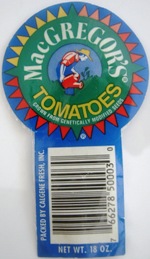
The presentation I gave at the Sacramento Sustainability Forum is now available on the Biotechsalon.com Resource page.  It contains photos of the point-of-purchase brochure that accompanied GE Flavr Savr™ tomatoes in U.S. grocery stores as well as information related to the sustainability, or lack thereof, of both current GE foods and others in the developmental pipeline.

Label on 1st GE product

Label on 1st GE product in U.S. (or any other) grocery store

I’ll be going into more detail about the presentation’s subject matter in future posts.  Please check back.

Posted in Biotechnology | Tagged | Leave a comment

Genetically Engineered Foods: Past, Present, and Future

I’ll be giving a brief talk entitled “Genetically Engineered Foods: Past, Present, and Future” at the Sacramento Sustainability Forum (SSF) this Thursday evening, November 17th, in the Rubicon Room of the SMUD Customer Service Bldg in Sacramento.  Doors open at 6:30pm and presentations start at 7:15pm.

Dr. Ignacio Chapela from U.C. Berkeley, Paul Towers from the Pesticide Action Network, “Organic Jack” Hertel of Foothill Organic Growers, and Pamm Larry with LabelGMOs.org will also give presentations that evening.

The topic of this month’s forum is “Sustainability of Our Food & Health.”  Please check out the SSF website for more details.

Posted in Biotechnology | Tagged , , | Leave a comment

Genetically Engineered Proteins Regulated as Food Additives: Another Very Short List

Regulation of most genetically engineered (GE) foods is currently not required by the U.S. Food and Drug Administration (FDA).  However, because many developers of GE foods have voluntarily consulted with the FDA about their products (and records of those consultations can be found on FDA’s web site) one can get a pretty good idea of the kinds of proteins being added to our food through the use of genetic engineering.

During the last 18 years most of the proteins added to food or feed products through genetic engineering confer resistance to pests like corn rootworm or viruses like papaya ringspot or herbicides like 2,4-D.  A few are meant to alter the constitution of edible oils or proteins; Monsanto, for example, has added a gene to corn that increases levels of the amino acid lycine making corn a more “complete” protein for animal feed.  And Pioneer Hi-Bred International added a red fluorescent protein to corn for selection purposes but does not intend for that protein to end up in seeds it sells to farmers.

But whatever the intentions of the developers, or the pros and cons of their products, proteins not previously found in our food have been added to it.  Shouldn’t these proteins be considered food additives and therefore be regulated by the FDA?

The protein added to the first genetically engineered agricultural product to be marketed in the United States was and the FDA did.

A protein that renders cells resistant to the antibiotic kanamycin and is normally found in the bacterium E. coli was present in the GE Flavr Savr™ tomatoes marketed in the United States in the mid-1990’s.  That protein was not normally found in (as part of) the foods we ate before the birth of the ag biotech industry.

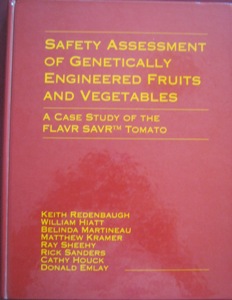
And so, in 1994, the FDA regulated it as a food additive. (And Calgene, the developer of the Flavr Savr™ tomato, published the safety studies it submitted to that agency; see photo.)

So why hasn’t the FDA treated the GE proteins added to our food and feed since then as food additives?  Most of them are bacterial or viral proteins and therefore no less innocuous than the kanamycin-resistance protein from E. coli.  And who knows what kind of GE proteins we may be eating in the not too distant future since this powerful technology can be used to add proteins from any organism to our food. (The gene encoding Pioneer Hi-Bred’s red fluorescent protein was isolated from a sea anemone.)

I don’t know why the FDA stopped treating proteins added to foods through genetic engineering as food additives. (Ironically, the agency’s Office of Food Additive Safety carries out the voluntary consultations with developers of GE products.)  But I do think the FDA’s handling of the Flavr Savr™ tomato made a lot of sense.  Foreign proteins are being added to our food and, whether added through genetic engineering or any other process, those proteins–logically anyway–are “food additives.” Shouldn’t they be regulated accordingly as was done in the case of the Flavr Savr™ tomato?

Posted in Biotechnology | Tagged , , , , , , , , , | 4 Comments

Genetically Engineered Foods in the U.S. that have been Labeled: A Very Short List

The genetically engineered (GE) sweet corn varieties that Monsanto hopes to sell to American farmers this fall apparently will not be the first GE sweet corn to show up in the produce sections of U.S. grocery stores.  According to Monsanto’s web site, pesticide-containing GE sweet corn has been on the market since 1998.  A GE crook neck squash containing a viral protein was commercially available several years earlier than that and a friend in the biotech business tells me it has been continuously marketed in this country ever since.  Additionally, estimates indicate that ingredients from various GE crops including corn, soybean, and cotton are present in 75-80% of the foods found on grocery store shelves in the United States.

As we Americans choose foods to purchase and feed to our families, however, there is no way for us to know which ones contain pesticidal proteins, or the “coat” protein from a virus, or a bacterial protein that confers resistance to an antibiotic, or any other foreign substance intentionally added to foods via genetic engineering.  That’s because GE additives are not listed on U.S. food labels.

But that wasn’t always the case.

The world’s first commercially available GE whole food was a tomato that carried a sticker proclaiming that it had been “grown from genetically modified seeds.”  Not only that, MacGregor’s® tomatoes were accompanied by tomato-shaped point-of-purchase brochures that explained how their “Flavr Savr™” seeds had been genetically engineered, that they contained an extra protein that made them resistant to the antibiotic kanamycin, and how consumers could contact the company that had developed them to receive even more information about them.

And those labeled GE tomatoes sold like hotcakes (at least initially).  The owner of one grocery store resorted to rationing them; customers could only purchase two MacGregor’s® tomatoes per day.  During the holiday season the same store owner made up gift boxes of GE tomatoes that customers could send to their friends and families.

Not everyone was happy about the GE tomatoes developed by Calgene, Inc. (with some help from yours truly), of course.  Jeremy Rifkin’s Pure Food Campaign staged a couple of small protests over them, for example.  But Calgene had been extremely transparent about the development, regulation, and marketing of its product and therefore all tomato purchasers–whether supporters, detractors, fence-sitters, or “others” with regard to genetic engineering–had a choice when it came to MacGregor’s® tomatoes.

Isn’t that the way a free market is supposed to work in a capitalist society like ours?  I believe it is and that is one reason I’ve started this blog.

In addition to the labeling issue I’d like topics of discussion with participants in the Biotech Salon to include: how genetic engineering specifically differs from traditional plant breeding; benefits, risks, and costs associated with this relatively new biotechnology; and how the current system for regulating the products of agricultural biotechnology in the United States might be improved.  Please stay tuned.

Posted in Biotechnology | Tagged , , , , | 7 Comments